Account serve Arun Jaitley has, time and again, said that India is a country of poor expense consistence, and that characterisation is likewise with regards to the enormous evaluations of the nation’s dark economy. The main thing, notwithstanding, is whether India is the slouch with regards to poor consistence or whether, when you represent India’s low per capita salary, the duty proportions look as terrible; similarly, significant, is the job of expense strategy in this situation. The Economic Survey of 2016 made them intrigue focuses to make.
The Survey plots tax assessment and spending levels for all nations and discovers India “is near the line of best fit in every one of the figures”. It at that point proceeds to complete a comparable exercise dependent on how popularity based a nation is and finds that India both assessments less just as spends not exactly most different vote-based systems — even here, however, with regards to direct expenses, India isn’t an anomaly.
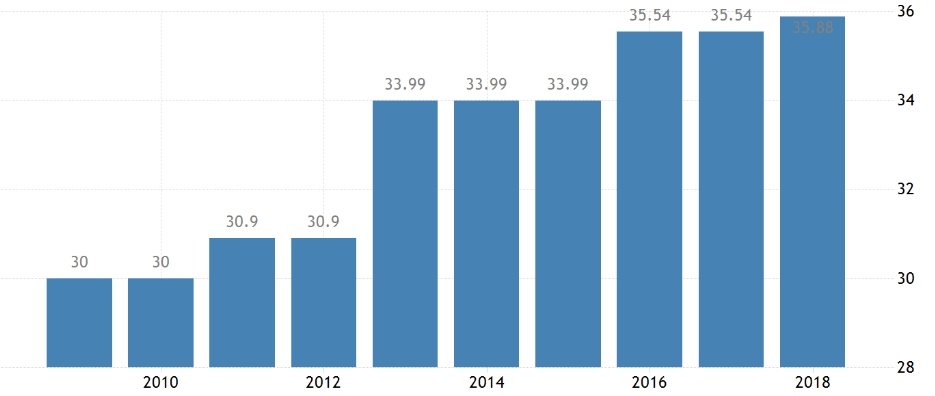
| PERSONAL INCOME TAX |
Direct duty accumulations have missed the mark by Rs 50,000 crore along these lines neglecting to meet the modified focus of Rs 12 lakh crore for 2018-19 monetary by virtue of poor individual annual expense accumulations. “We will draw near to in all probability the prior focus of Rs 11.5 lakh crore for 2018-19 as estimations are at the last stage not past that… We won’t meet upward overhauled focus of Rs 12 lakh crore,” an official source said. Sources said the objective of individual annual assessment of Rs 5.29 lakh crore was not met by nearly a similar setback measure of Rs 50,000 crore, which hauled down the immediate expense accumulations for the monetary 2018-19. They additionally said that the corporate duty focus of Rs 6.71 lakh crore was pretty much met with minor variations.
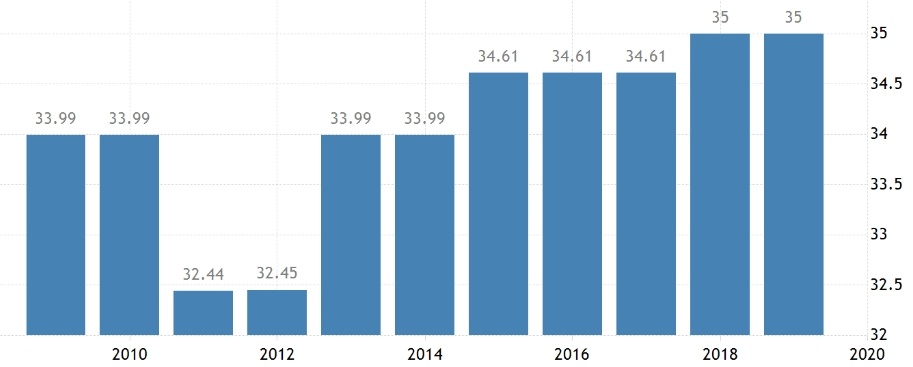
| CORPORATE INCOME TAX |
The Survey in 2016, truth be told, makes a fascinating point about the job of government in this. Since numerous examinations put China’s number of citizens as more than those of India, notwithstanding when its salary levels were like those of India, the Survey asks “what number of citizens (would there) have been in 2012-13 if the edge had been kept up at Rs 1,50,000 (as far as possible in 2008-09)… we find that there would have been an extra 1.65 crore units joined inside the tax collection framework (an expansion of about 39.5 percent) and duty incomes would have been around Rs 31,500 crore more noteworthy … India’s assessment GDP would have expanded by 0.32 percent just by not having raised the limit so liberally”. Presently add to this the way that, with farming not burdened, over 60% of the populace is out of the ambit of the expense framework or the different exclusions given for senior natives, and so forth—as indicated by the 2016 Survey, “about 85 percent of the economy is outside the assessment net”.
In spite of this, the uplifting news is, with rising per capita livelihoods, the expense to-GDP levels are rising great—this is both because of expanding formalization of the economy and a conceivable tipping moment that per capita earnings ascend over a specific dimension just as the way that the administration’s ability to guarantee consistence additionally rises. Between 2000-01 and 2017-18, while India’s GDP rose 7.7 occasions, focal assessment incomes rose 10.3 occasions, because of which charge to-GDP ascended from 8.7% to 11.6% and, if all goes to design, this will ascend to 12.1% in FY19. During this period, individual personal assessments, as a proportion to GDP, are up from 1.5% to 2.6% and are anticipated to ascend to 2.8%. Corporate tax assessment levels (as an offer of GDP), have been falling for quite a long while, with regards to the abating of corporate gainfulness, and had this not occurred, charge incomes would have become much quicker. India can get a lot of higher charges with more consistence—the most recent Survey has a great deal of information on how different nearby bodies are not gathering property imposes satisfactorily—and the job of Aadhaar in this can’t be over-underlined, yet perceive that assessment incomes can’t be separated from the dimension of financial improvement.
The Goods and Services Tax (GST) changes has brought about expanded assessment base, higher accumulations and simplicity of exchange. While showing the Interim Budget 2019-20 in Parliament today, the Union Minister for Finance, Corporate Affairs, Railways and Coal, Shri Piyush Goyal said “The Goods and Services Tax (GST) changes waited on during the past Government for very nearly 10 years. Our Government executed the GST, which is without a doubt the greatest tax collection change attempted since Independence.” Seventeen distinctive expenses collected by the Central and State/UT Governments with falling impact of assessment on duty, were merged into one GST. India turned into a typical market. GST has brought about expanded duty base, higher accumulations and simplicity of working together. This will lessen the interface between the citizens and the Government for everyday activities and evaluations. The Minister said that currently returns are completely on the web and e-way charge framework is set up. Between state developments have turned out to be quicker, progressively effective, and bother free with no Entry Tax, check posts, and truck lines among others.
GST plans to profit little dealers, producers and specialist co-ops. Exceptions from GST for independent ventures has been multiplied from Rs 20 lakh to Rs 40 lakh. Further, private companies having turnover up to Rs. 1.5 crore have been given an alluring organization conspire wherein they pay just 1% level rate and need to document one yearly return as it were. Essentially, little specialist organizations with turnover upto Rs. 50 lakhs would now be able to choose piece plan and pay GST at 6% rather than 18%. In excess of 35 lakh little brokers, producers and specialist co-ops will profit by these dealer amicable measures. Before long, organizations involving over 90% of GST payers will be permitted to record quarterly restore, the Minister included.
The Finance Minister affirmed that notwithstanding such significant rate decreases and relaxations, income patterns are empowering. The normal month to month charge accumulation in the present year is Rs. 97,100 crores for every month when contrasted with Rs. 89,700 crores for every month in the principal year. The State incomes are improving with ensured 14% yearly income increment for the initial five years.
 POOR TAX COLLECTION RATES IN INDIA